Shinji Kanai Notes & Research · CISSP
Cognitive tools  ·  secure by design

Tools for clearer thinking in AI-assisted work.

A curated collection of working tools, prototypes, and design patterns built to reduce cognitive friction, clarify decisions, and make AI-supported work more accountable. Each tool is treated as a thinking aid first — not a replacement for human judgment.

Reflection Workflow redesign Decision support Secure cognition

A professional collection of cognitive tools.

The collection brings together practical tools for thinking, writing, communication, and decision-making. Some are active tools, some are structured prototypes, and some are design patterns being tested through everyday AI work.

Active toolAIBO

AI Briefing Orchestrator

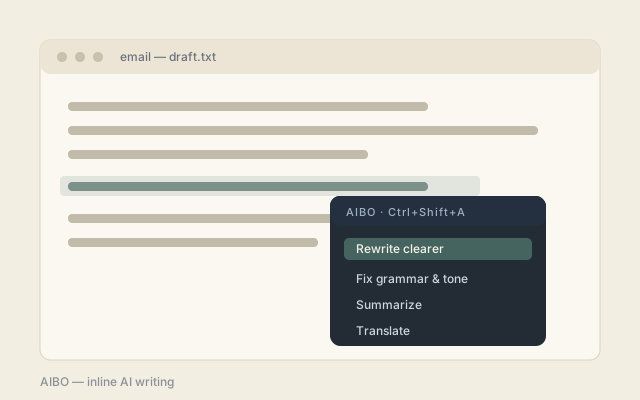
Transforms rough context, notes, and priorities into structured briefs that clarify what matters, what is uncertain, and what should happen next.

  • Turns scattered inputs into coherent briefings
  • Highlights open questions and missing context
  • Keeps final interpretation with the human user
Live researchGraph

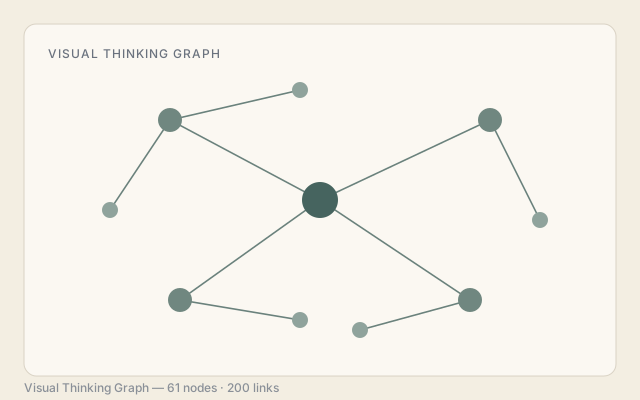
Visual Thinking Graph

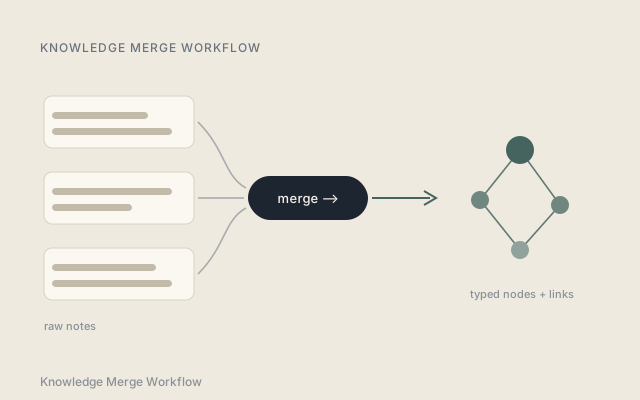
Connects research questions, notes, observations, and conclusions so ideas can be explored as relationships rather than isolated documents.

  • Reveals links between concepts and experiments
  • Supports non-linear exploration of the research
  • Creates a visible trail of evolving thought
PrototypeReflect

Reflection Prompt Library

A set of structured prompts for self-analysis, post-work reflection, and turning repeated experiences into reusable lessons.

  • Captures decisions while context is still fresh
  • Separates observation from interpretation
  • Builds better personal feedback loops
PatternComms

Communication Lens

A review pattern for checking whether AI-assisted communication preserves nuance, audience fit, and professional accountability.

  • Tests for clarity, tone, and implied assumptions
  • Flags places where nuance may be flattened
  • Helps keep human intent visible
PrototypeDecide

Decision Journal

A lightweight structure for recording options, trade-offs, risks, confidence, and later outcomes in AI-supported decision-making.

  • Makes reasoning inspectable after the fact
  • Records confidence and uncertainty explicitly
  • Supports learning from future outcomes
Design studyWorkflow

Friction Mapper

A workflow analysis pattern for finding repeated cognitive friction and identifying where AI can responsibly reduce burden.

  • Maps repeated steps, handoffs, and bottlenecks
  • Distinguishes useful effort from avoidable friction
  • Frames automation around trust and control

How each tool is evaluated.

The collection is intentionally practical. Tools are judged by whether they improve the quality of thinking, reduce unnecessary friction, and preserve accountability when AI enters the workflow.

01

Clarify the cognitive task

Define the thinking job first: briefing, deciding, reflecting, synthesizing, or communicating.

02

Expose assumptions

Make inputs, uncertainties, constraints, and interpretive leaps visible before action is taken.

03

Keep judgment human

Use AI to organize and challenge thinking while keeping ownership with the person using the tool.

04

Review for trust

Check privacy, security, traceability, and whether the output can be explained in plain language.

Security and accountability are part of the tool design, not a final review step.

Minimum necessary context Tools should ask for only the information needed for the cognitive task and avoid collecting sensitive context by default.
Traceable reasoning Outputs should make sources, assumptions, uncertainty, and recommended next steps easy to inspect.
Human accountability The tools are designed to support reflection and decision quality without hiding who is responsible for the final choice.

Explore the research map behind the tools.

Open the graph

Interested in careful, secure cognitive tools for AI-assisted work? Start a conversation.

Author
Shinji Kanai
CISSP · writing in the open
Based in
Sydney, Australia
Working globally
Elsewhere